Model of the Sacrificial Banquet House (Nayarit region)
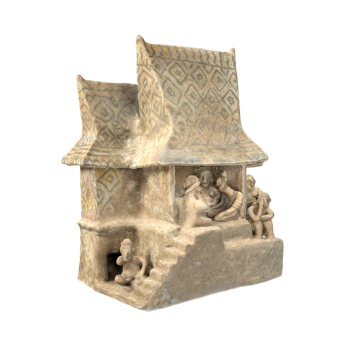
This is the "sacrificial banquet house model" of the Nayarit culture. The model comes from the Nayarit region of western Mexico in ancient Central America and belongs to the Eastlandel Rio culture. It was made between 100 BC and 300 AD. The model is made of terracotta with residual pigments. The figures are stylized, showing scenes of people sitting or standing under the eaves for social activities, possibly preparing food or performing rituals. The original sculpture is in the Museum of the Art Institute of Chicago.
Dyer Abbey
This is located in the ancient city of Petra, Jordan's famous building Dyer Monastery (Ad-Deir), as the film "Transformers 2" shooting location. The Abbey of Dyer, one of the largest monuments in Petra, is located in a high mountain in the northwest part of the archaeological site area and requires climbing about 800 steps to reach it. In the Byzantine period, the inner back wall was carved with a cross and was converted into a Christian chapel, hence the name "Abbey". The ancient city of Petra is listed as a UNESCO World Heritage Site for its unique rock carving architectural art and historical value.
Chinese Lingnan Traditional Brick Carving

Brick carving is a kind of decorative art in Chinese traditional architecture. Brick carving is to carve out landscapes, flowers, figures and other patterns on fired green bricks. It is often used as a component or decoration of ancient buildings, such as gatehouses, lintels, walls, etc. There are different schools of brick carving in various parts of China. For example, Lingnan brick carving (taking the Chen Clan Temple in Guangzhou as an example) is famous for its fine and exquisite carving. It often uses a variety of techniques such as high relief and transparent carving, even up to seven or eight layers, creating a far-reaching effect. Brick carving works usually express auspicious meanings or historical stories, reflecting national customs and aesthetic taste.
3D Model Rendering of the Great Hall of Jinshan Temple
Located in Zhenjiang City, Jiangsu Province, China, Jinshan Temple is one of the famous ancient Buddhist temples in China. It was built in the Eastern Jin Dynasty. The roof of the main hall adopts the top of the mountain with heavy eaves (also known as the Nine Ridges Hall), which is one of the higher-grade architectural forms in ancient Chinese architecture. The roof is covered with yellow glazed tiles, which is a common color used in ancient Chinese royal or important temple buildings, symbolizing solemnity and dignity. The four corners of the building eaves are tilted upward to form a beautiful cornice shape, which is a typical feature of traditional Chinese architecture.
Court of the Duke of Targovishti
"The Princely Court of Târgoviște" (The Court of Târgoviște) is the core historical relic of the famous historical city of Târgoviște in Romania. It was once the power center and political, religious and cultural hub of the ruler (duke/grand duke) of the Principality of Wallachia (1330-1859). It is not only a material witness of the "Golden Age" of Wallachia, but also an important symbol of Romanian national identity and the political pattern of the Balkans in the Middle Ages.
Roman Temple of Evora
The "Roman Temple of Évora" is a remnant of an ancient Roman religious building in the historic city of Évora () in southern Portugal, located near the "Roman Square" (Praça do Império) in the center of the city. It is one of the most well-preserved Roman temples in the Iberian Peninsula. It has witnessed the cultural penetration and religious spread of the Roman Empire in the Iberian Peninsula. It is also the core symbol of Evora as the "city of Roman heritage.
Triple Pagoda of Faji Temple in Japan
The signboard of Faji Temple is the Triple Pagoda, which is the oldest triple pagoda in Japan, built during the Asuka period in 706 AD. At that time, China was in the Tang Dynasty, and Wu Zetian had just passed away the previous year. Emperor Zhongzong of Tang, Li Xian, succeeded to the throne. The Asuka Era in Japan began in 592 AD, when the first female emperor in Japanese history, Emperor Tsuchigu, ascended to the throne. In this year, the Chinese Mainland was in the 593 year of Emperor Wen of the Sui Dynasty's "Kaihuang Zhizhi", when the ancient emperor appointed the prince of the stables, the son of tomorrow's emperor, as the crown prince and regent. This was the famous "Prince Noble" in Japanese history and Japanese Buddhist history.
Kubyauk gyi Temple in Bagan, Myanmar
It is an important historical site located in the famous Bagan region of Myanmar. Built in the 10th century AD, it is a Buddhist temple. It is one of the well preserved ancient buildings in the Bagan region. Renowned for its exquisite murals. The murals inside the temple depict Buddhist stories and traditional patterns, with strong cultural and religious significance. Built with red bricks, it has a typical Burmese architectural style. There is a towering dome and delicate decorations that embody the unique charm of Burmese art. Despite experiencing the baptism of time and natural disasters, it remains an important destination for tourists and believers in the Bagan region.
The dilapidated memorial archway of Chinese ancient buildings
Memorial archway is a common characteristic architectural form in ancient Chinese architecture. It first appeared during the Spring and Autumn Period and the Warring States Period. It is a unique arched building, usually constructed from stone or wood. Usually set at the entrance of important places such as city gates, ancestral halls, and cemeteries, it has symbolic significance and commemorative functions. The structural features include three parts: lintels, columns, and crossbeams. The architrave is the top part of the memorial archway, usually carved with patterns and words; The columns are the columns supporting the memorial archway, which can be single columns or multiple columns; The crossbeam connects two columns, serving to stabilize and reinforce them. It has become one of the representatives of traditional Chinese architecture.
Chinesischer Turm
Chinese pagodas are a unique form of ancient Chinese architecture. It is a multi story tower building typically constructed from brick, wood, or stone materials. As an important component of Buddhist temples, it is often used to store Buddhist scriptures and Buddha statues. It has a long history and rich cultural connotations. They originated from Buddhist pagodas in ancient India and have developed a unique style and characteristics through improvements and innovations in China. The design of the pagoda reflects the aesthetic concepts of traditional Chinese architecture, integrating Buddhist teachings and Taoist beliefs. Very delicate in both structure and decoration. They typically have multiple levels of stairs and ascending roofs, forming a unique appearance.
Kopan Maya Site Altar
The ancient city of Copan is an important site of the Maya civilization, located in western Honduras. There is an altar in the ruins called AltarCopan. Built in the 6th century AD, it is one of the important cultural relics of the ancient city of Copan. The shape is a rectangular platform with exquisitely carved reliefs on top. The reliefs depict scenes from Maya mythology and history, including deities, rulers, and other characters from Maya mythology. These reliefs are presented with intricate carvings and details, reflecting the artistic style and religious beliefs of Maya culture. The exquisite reliefs depict scenes of Maya mythology and history, which are of great significance for studying Maya civilization and its religious beliefs.
Ancient Maya Civilization Stone Tablet
A stone monument located in Copan, Honduras, is one of the relics of the ancient Maya civilization. Copan is an ancient Mayan city ruins located in the Copan Valley in western Honduras. An important stone monument was discovered in this site. It is a huge pillar, usually carved from a single boulder, often used to commemorate important events or rulers. Carving symbolic patterns, pictograms, and decorations of ancient Maya civilization, showcasing the artistic and religious features of Maya culture. It may have been built to commemorate a ruler or important event. The Kopan Site is an important archaeological site.
Hindu temples in Rajasthan
A Hindu temple located in Menal, Rajasthan, India. It is a temple dedicated to the Hindu god Shiva and one of the important religious and cultural sites in the region. Built in the 10th century AD, it is one of the representatives of traditional architectural styles in Rajasthan, India. It is renowned for its exquisite carvings and architectural details, showcasing the uniqueness of Hindu art and architecture. Surrounded by lush green forests and beautiful natural landscapes, creating a peaceful and sacred atmosphere. It is an important destination for Hindu believers and pilgrims. There is a statue of Shiva enshrined in the temple
The White Chapel of the Ancient Egyptian Pharaoh Cenasot I
The white chapel of the ancient Egyptian pharaoh Cenasot I was an important building during the Middle Kingdom period of ancient Egypt and is considered part of the temple architecture of Cenasot I. Built in the 19th century BC, located within the Abidos ruins in Egypt. Constructed from stone, with a white appearance and decorated with intricate reliefs and carvings. It was built by Censorate I to worship his ancestors and gods. It is considered a sacred place, where statues and reliefs of several pharaohs and gods are enshrined. It is an important historical site that provides valuable information for studying ancient Egyptian culture and religion.
Popular Models
Random Model
World of Tanks T95E6 Tank
1009 View
Barricade
961 View
Samsung Gear VR
1053 View
Solomon (Salomon)XT 6 sneaker
886 View
Nereid Monument
936 View